





Trade
Overview
TT Platform
Description
Task
Browser Access
Description
Task
Videos
TT Desktop
Description
Task
Videos
Reference
Workspace Windows
Description
Task
Videos
Widgets
Description
Task
Preferences
Description
Viewing Market Data
Time and Sales
Task
Reference
Description
Depth
Description
Task
Reference
Market Grid
Description
Task
Videos
Reference
Product Grid
Description
Task
Reference
Spread Matrix
Description
Task
Videos
Reference
Basic Order Entry
TT Order Types
Description
Task
Videos
Reference
Case Studies
TT Premium Order Types
Description
Task
Reference
Order Ticket
Description
Task
Use Cases
Reference
MD Trader®
Description
Task
Videos
Reference
Order Profiles
Description
Task
Reference
Routing Rules
Description
Task
Blocktrader
Description
Task
Videos
Reference
Trading Crypto on TT
Description
Task
Videos
Reference
Trading on B3
Order Management
Order Book
Description
Task
Reference
Floating Order Book
Description
Task
Reference
Fills
Description
Task
Reference
Positions
Description
Task
Reference
Orders and Fills
Description
Task
Reference
Audit Trail
Description
Task
Reference
Audit Query
Description
Task
Reference
Account List
Description
Task
Videos
Reference
Position Manager
Description
Task
Reference
Alert Manager and Alert Viewer
Description
Task
Videos
Reference
Account & User Restrictions
Description
Task
Reference
Balances
Description
Task
Reference
TT® OMS
Care Orders
Description
Task
Videos
Reference
Lock and Release
Description
Task
Bulking
Description
Task
Videos
Stitching and Splitting
Description
Task
Combining
Description
Task
Order Passing
Description
Task
Use Cases
Order Exceptions
Description
Task
Options
Options on TT
Description
Videos
Options Chain
Description
Task
Use Cases
Videos
Reference
Options Trade Monitor
Description
Task
Videos
Reference
Vol Curve Manager
Description
Task
Use Cases
Videos
Reference
Electronic Eye
Description
Task
Videos
Reference
RFQ Viewer
Description
Task
Videos
Reference
RFQ with Counterparties
Description
Task
Counterparty Manager
Description
Task
Strategy Creation
Description
Task
Use Cases
Reference
Options Risk
Description
Task
Videos
Reference
Options Risk Matrix
Description
Task
Videos
Reference
Watchlist
Description
Task
Videos
Reference
Expiration Manager
Description
Task
Volatility Calculator
Description
Task
TT Uncovered 2.0
Description
Task
TT Uncovered 3.0
Description
Task
QuikStrike
Description
Task
Spread Trading
Autospreader
Description
Task
Use Cases
Videos
Reference
Autospreader Rules
Description
Task
Videos
Reference
Hedge Manager
Description
Task
Videos
Reference
Trading in Yield
Description
Task
Use Cases
Reference
Aggregator
Description
Task
Videos
Reference
Algo Trading
Algo Dashboard
Description
Task
Videos
Reference
Template Manager
Description
Task
Order Management Algos (OMAs)
Autotrader
Description
Task
Reference
Videos
Excel integration with TT
Description
Task
Videos
Reference
Market-Making Algos
Analytics
Charts
Description
Technical Indicators
Task
Videos
Reference
Trader Analytics
Description
Task
Reference
ADL
ADL Overview
Introduction to ADL
Description
Task
Videos
Reference
ADL Basic Concepts
Description
Task
Reference
Building your first algo
Lessons
Advanced concepts
Description
Task
Case Studies
Jump blocks
Group blocks
Virtualized blocks
Library blocks
Trading Blocks
Discrete blocks
Arithmetic blocks
Basic blocks
Logic blocks
Miscellaneous blocks
Setup
Setup Overview
Getting Started
Description
Task
Videos
Reference
Supported Order Types and TIFs
Company Administration
Connections
Description
Task
Videos
Reference
Accounts
Description
Task
Videos
Use Cases
Reference
Users
Description
Task
Videos
Reference
Company
Description
Task
Reference
Order Tag Defaults
Description
Task
Account Administrators
Description
Task
TT Premium Services
Description
Task
TT Access
Description
Task
Advanced Features
Description
Risk Management
Risk Administration
Description
Task
Risk Limits
Description
Task
Videos
Reference
Pre-Trade Portfolio Risk
Description
Task
Reference
Order Cross Prevention
Description
Task
Videos
KRM Limits
Description
Task
TT® OMS
TT OMS Administration
Description
Task
Use Cases
Reference
Exchanges: Americas
B3
Description
Task
CBOE
Description
Task
Cboe FX
Description
Task
Reference
CFE
Description
Task
CME
Description
Task
Dealerweb
Description
Task
EBS Direct
Description
Task
EBS Market
Description
Task
Fenics
Description
Task
FMX
Description
Task
FMX_USTF
Description
Task
Goldman Sachs Commodity Blocks (GSCB)
Description
Task
Referece
ICE
Description
Task
MexDer
Description
Task
MIAX_FUT_CH
Description
Task
MIAX_FUT_NY
Description
Task
MX
Description
Task
Nodal
Description
Task
NFI
Task
Exchanges: EMEA
ATHEX
Description
Task
BIST
Description
Task
DGCX
Description
Task
EEX
Description
Task
EPEX SPOT
Description
Task
Reference
Eris
Description
Task
Eurex
Description
Task
Videos
Euronext
Description
Task
GFO-X
Description
Task
ICE_L
Description
Task
JSE
Description
Task
LME
Description
Task
LME NTP
Description
Task
LSE
Description
Task
MEFF
Description
Task
NDAQ_EU
Description
Task
NASDAQ_NED
Description
Task
Nord Pool
Description
Task
Reference
WSE
Description
Task
Exchanges: Asia/Pacific
ABX
Description
Task
ASX
Description
Task
FEX
Description
Task
HKEx
Description
Task
JPX
Description
Task
NSE
Description
Task
NZX
Description
Task
SGX
Description
Task
SGX GIFT
Description
Task
TAIFEX
Description
Task
TFEX
Description
Task
TFX
Description
Task
CoinFLEX
Task
Exchanges: Crypto
Coinbase
Description
Task
Kraken
Description
Task
FIX Support
FIX Ruleset
Description
Task
FIX Sessions
Description
Task
Secondary Accounts
Description
Task
Monitor
TT Mobile
TT Backtesting
APIs
TT REST API 2.0
Getting Started
API Reference
TT REST API 2.0 (UAT)
Getting Started
API Reference
TT .NET SDK
Getting started with TT .NET SDK
Creating the application framework
Working with instruments
Subscribing for market data
More about prices
An in-depth look at the Price class
Working with orders and fills
Handling trade subscriptions
Working with trade subscriptions
Working with Algos
Algo Server
TT Order Types
TT Premium Order Types
Advanced Concepts and Options
Appendix
TT CORE SDK
Getting Started with TT Core SDK
Creating Application Framework
Working With Instruments
Subscribing for Market Data
Working with Orders and Fills
Creating a TT Application Server
Appendix
TT Trade Surveillance
Overview
Using TT Trade Surveillance
Cluster View
Core Models
Market Abuse Models
Cross Product Models
Spoofing Models
Improperly Matched Trade Models
Market Rate Models
Trading Behaviors Models
Miscellaneous Models
Configurable Models
Reports
Wachlists
Reference
TT FIX Services
TT FIX General
Getting Started
FIX Message Structure
Session messages
TT FIX Order Routing
Overview
TT FIX message conversations
Supported application messages
TT FIX Market Data
Overview
TT FIX message conversations
Supported application messages
TT FIX Drop Copy Out
Overview
TT FIX Message Conversations
Supported application messages
Compliance Feed messages
TT FIX Drop Copy In
Overview
Supported application messages
TT FIX Gateway
Getting Started
FIX Message Structure
Components
Session messages
Price Gateway Messages
Order Gateway Messages
TT FIX Recovery
Overview
FIX Recovery Methods
Supported application messages
Compliance Feed Messages
MiFID II Support

Creating and managing application keys

On this page

Using the App Keys tab, you can create and manage application keys for logging in to TT with your own custom TT Core SDK, TT .NET SDK, and TT REST API trading applications. When you create an application key, Setup will generate a key value that you can copy and paste into the login calls of your application.
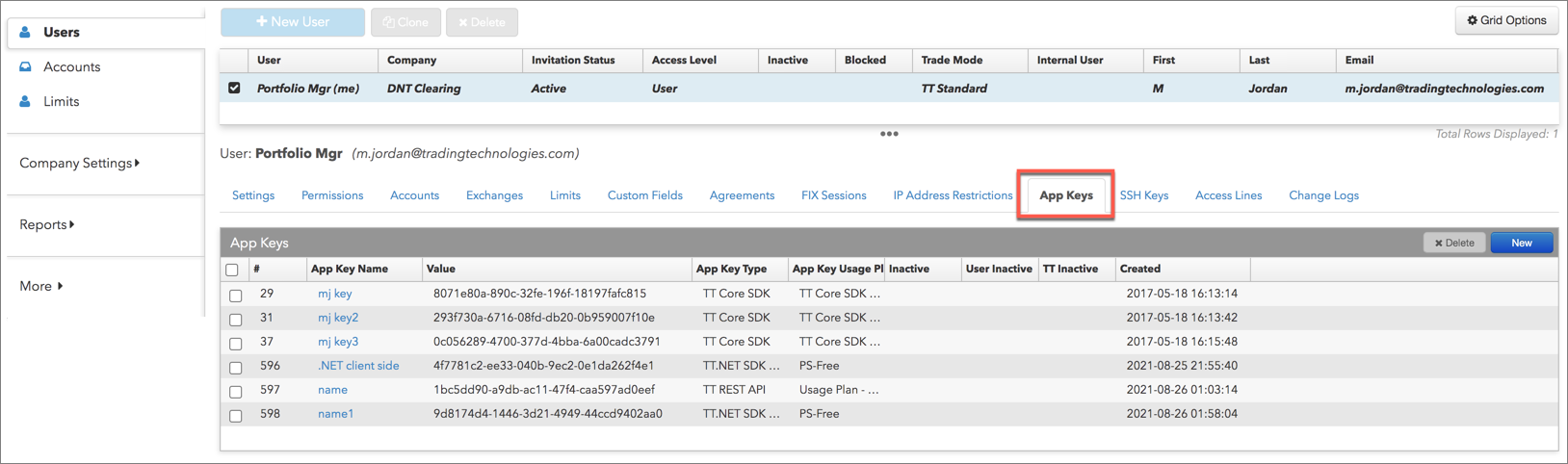
When you log in to TT via a trading application, TT authenticates your application key and allows you to retrieve a token for accessing the services on the TT platform. After logging in with your trading application, you will use the same order permissions, risk settings, and account restrictions, etc., that have been assigned to you in Setup.

The same order permissions and account restrictions assigned to you as a user in Setup also apply to you when you log in and trade via your key-based trading application.

Whether you log in via a browser or key-based trading application, your same user order permissions and account restrictions apply in both cases.

As a company administrator, you can enable market data entitlements per user and exchange for TT .NET SDK and TT Core SDK application keys. The exchange determines if your trading application is accessing market data for “display” or “non-display” purposes.

Creating an application key

As a user or company administrator, you can create and manage your own application keys. In addition, as a company administrator, you can also create and manage application keys for provisional users in your company. However, if a provisional user accepts an invitation to join your company, Setup deletes the application keys and the user must then create their own application keys.

Note: You can only create an application key for your own username in Setup.

To create an application key:

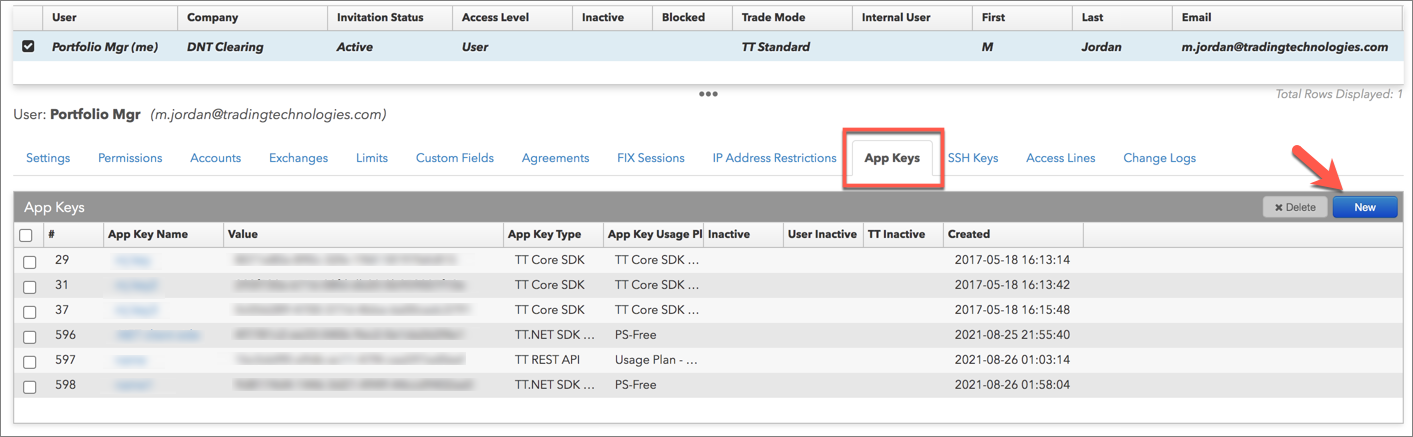
  1. Click Users in the left navigation panel and select a user in the data grid.
  2. Click the App Keys tab.
  3. In the title bar of the App Keys data grid, click New.
  4. In the Create New Application Key screen, enter a user-defined name in the Application Key Name field.

    The key name must be unique.
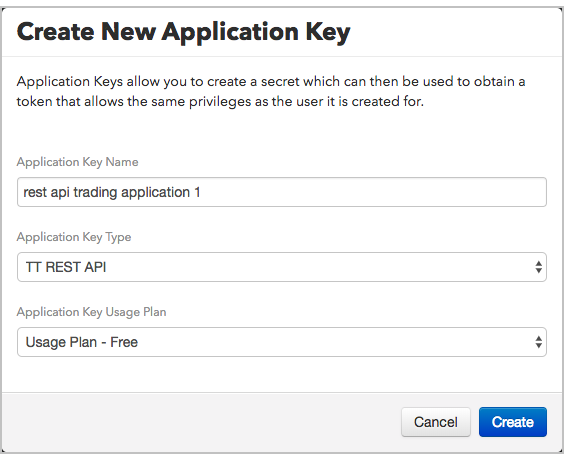
  5. Click the Application Key Type selector and choose one of the following:
    • TT REST API — Allows you to run TT REST API applications. Visible only if “Can create TT API REST Key” is enabled in Users | Settings.
    • TT Core SDK — Allows you to run custom TT Core SDK or TT .NET SDK Server Side trading applications.
    • TT .NET SDK Client Side — Allows you to build your own client side “display only” trading applications. Visible only if “Can create TT .NET SDK Client Side key” is enabled in Users | Settings.
  6. TT .NET SDK Client Side – Non Display — Allows you to build your own client side “non-display” trading applications as defined by the exchange. Visible only if “Can create TT .NET SDK Client Side Key” is enabled in Users | Settings.
  7. Click the Application Key Usage Plan selector to choose a plan based on the application key.

    Note: Using TT REST API or TT .NET SDK Client Side application keys requires you to select a usage plan that can incur additional costs. For more information about the costs associated with the usage plans, contact TT Customer Success.

    For TT REST API application keys, select one of the following plans:

    • Usage Plan – Free — Allows you to develop and test TT REST applications in UAT only.
    • Usage Plan – Low — Allows you to run TT REST applications in the Live environment with limit of 5 requests per second and 15,000 requests per day.
    • Usage Plan – Medium — Allows you to run TT REST applications in the Live environment with limit of 10 requests per second and 30,000 requests per day.
    • Usage Plan – High — Allows you to run TT REST applications in the Live environment with limit of 25 requests per second and 75,000 requests per day.

    For TT .NET SDK Client and TT .NET SDK Client – Non-Display application keys, select one of the following plans:

    • PS-Free: Allows the TT .NET SDK Client Side application to create a maximum of 200 simultaneous price subscriptions. Available only in the UAT environment.
    • PS-Low: Allows the TT .NET SDK Client Side application to create a maximum of 25 simultaneous price subscriptions. Available only in the prod-sim / prod-live environments.
    • PS-Medium: Allows the TT .NET SDK Client Side application to create a maximum of 50 simultaneous price subscriptions. Available only in the prod-sim / prod-live environments.
    • PS-High: Allows the TT .NET SDK Client Side application to create a maximum of 200 simultaneous price subscriptions. Available only in the prod-sim / prod-live environments.
    • PS-Reserve: Allows the TT .NET SDK Client Side application to create an unlimited number of price subscriptions. Available only in the prod-sim / prod-live environments. Note: PS-Reserve requires a dedicated TT Edge Server.

    TT Core SDK and TT .NET SDK Server Side application keys use the TT Core SDK Default usage plan only.

  8. Click Create.

    The application key is generated and displayed in the Secret field.
  9. Click Copy Secret to Clipboard to save the value on your machine.
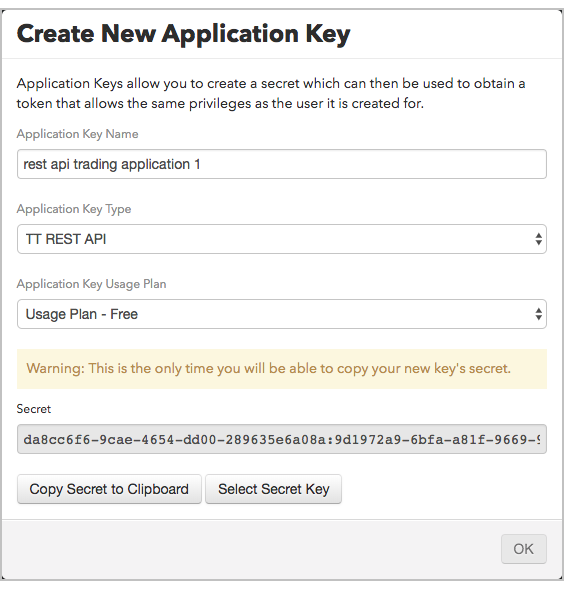
    Add the copied secret to the login call in your REST API trading application.

  10. To exit and close the Create New Application Key screen, click OK.

Managing application keys

Using the App Keys tab, you can delete, rename, or deactivate an existing application key.

To manage application keys:

  1. Click Users in the left navigation panel and select a user in the data grid.

    Multiple users can be selected.
  2. Click the App Keys tab.
  3. Select an application key in the App Keys data grid.

    Multiple keys can be selected.
  4. To deactivate and delete the application key, click Delete.

    Note: Ensure that the deleted key is removed and replaced in your trading application.
  5. To rename the application key, click the Name and enter the new name.
  6. To deactivate an application key, click the Inactive checkbox. When the box is checked, the application key is inactive.

    Note: If needed, ensure that the deactivated key is replaced in your trading application.

    To re-activate an application key, uncheck the Inactive checkbox.
  7. Click Save Changes.

Note: When the TT Inactive setting is checked, it indicates that a TT Administrator has manually disabled the app key. To reactivate the app key, contact your company administrator.