




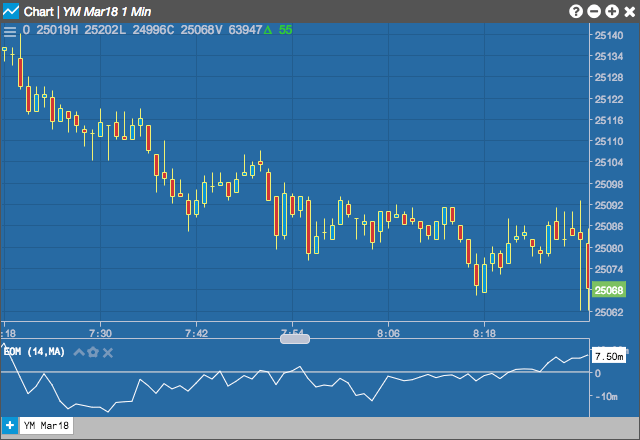
Ease of Movement, developed by Richard W. Arms, Jr., relates price change to volume and is particularly useful for assessing the strength of a trend. High positive values indicate the price is increasing on low volume and strong negative values indicate the price is dropping on low volume.
Configuration Options
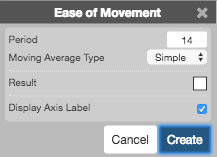
- Period: Number of bars to use in the calculations.
- Moving Average Type: Type of moving average to use in the calculations:
- Simple
- Exponential
- Time Series
- Triangular
- Variable
- VIDYA
- Weighted
- Welles Winder
- Hull
- Double Exponential
- Triple Exponential
- Color Selectors: Colors to use for graph elements.
- Display Axis Label: Whether to display the most recent value on the Y axis.
Formula
The four calculation below are required for Ease of Movement indicator:
\[Distance\;Moved = DM = \left(\frac{High_{current} – Low_{current}}{2}\right) – \left(\frac{High_{previous} – Low_{previous}}{2}\right) \]
\[Box Ratio = BR = \left(\frac{\frac{Volume_{current}}{1,000,000,000}}{High_{current} – Low_{current}}\right) \]
Calculate a one period EOM:
\[EOM_{1} = \frac{DM}{BR}\]
Calculate the moving average where the user can pick from various moving average types:
\[EOM_{n-period MA} = MA(EOM_{1})\]